


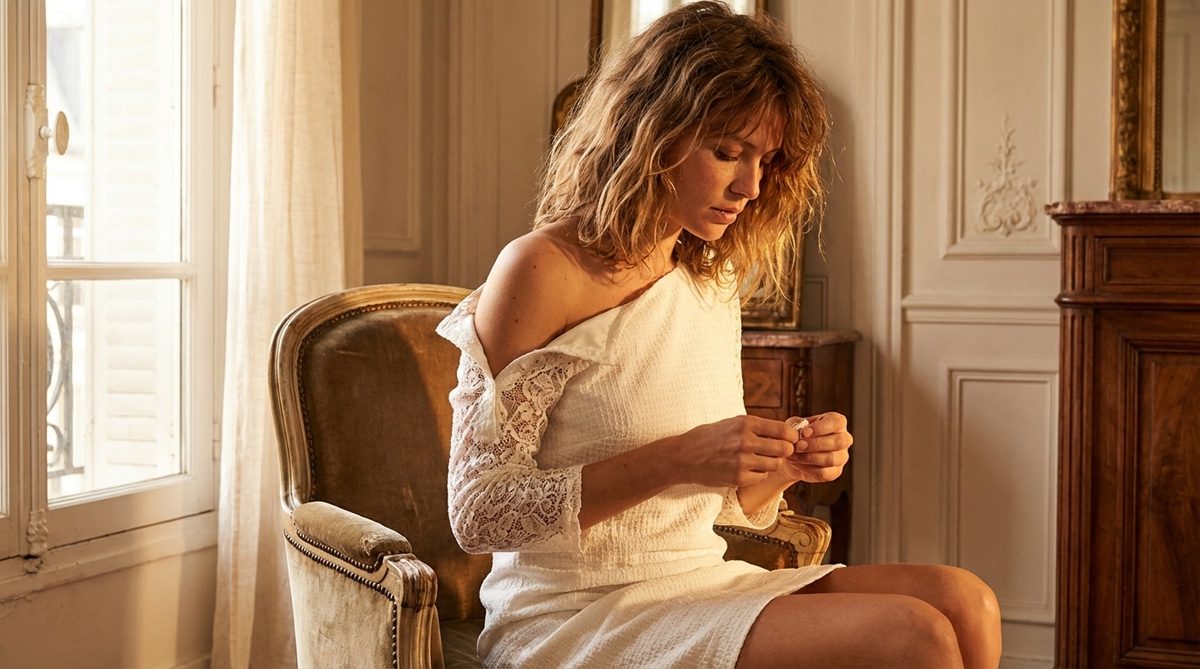
You spent months hunting for “the one.” Your budget took a massive hit. And then? It sits in a garment bag, gathering dust the moment the last guest leaves.
It’s absurd.
We are in a moment where our relationship with fashion is shifting. Buying a single-use garment for a few hours feels wrong. Especially when the sun is out and we’re thinking about spring. Can we keep the magic of the wedding without buying something that just sleeps in the dark?
The answer isn’t to compromise. It’s to rethink the structure entirely.
The Problem with Single-Use Wedding Gowns
The financial and ecological cost of a traditional gown is staggering. For zero-waste advocates, it’s heartbreaking. I grew up near the Brittany coast, where the sea taught me to respect nature and hate waste. Seeing meters of exquisite silk abandoned in a closet is a punch to the gut.
But the bride of today is different. She demands meaning. She wants a sustainable wardrobe, even at the altar. This isn’t about a fleeting fancy. It’s about balancing eternal love with ecological conscience. The idea of maximizing the value of your most expensive purchase is no longer radical. It’s essential.
Enter the Modular Wedding Dress
This is where versatility becomes liberation. The solution isn’t a new dress. It’s a design approach.
Mastering Layering and Detachable Elements
Modern designers are using hidden clasps and invisible buttons to create multi-layered looks. You stack pieces deliberately. A pure bodice pairs with a delicate lace corset or a light cape. It’s architectural.
Once the ceremony ends, the drama shifts. You remove the long, heavy train. You drop the bulky overskirt. Suddenly, the silhouette slim down. You’re ready to dance. The gown transforms into a cocktail dress or a structured top for the next day.
Marie de Boissieu’s Modular Philosophy
The French creator Marie de Boissieu embodies this circular elegance. She treats her creations like a stylistic puzzle. Each piece assembles and disassembles at will.
Think of the wedding outfit as a series of interchangeable components, not a single monolithic object.
Her designs include buttoned tops, reimagined belts, and clip-on balloon sleeves. The possibilities are nearly infinite. You build your look step by step.
Fabrics That Fit Real Life
Success depends on fabric choice. Brands focusing on this approach use noble materials that work outside the wedding context. Silk crepe or cotton mousseline drapes fluidly. These luxurious fabrics integrate seamlessly into a regular closet.
Straight or slightly flared cuts make returning to daily life easier. You leave the spotlight behind, but you keep the clothes.
From Town Hall to Terraces: Wearing It All Year
The challenge doesn’t end the next day. It’s about taming these fabrics for a random Tuesday morning.
When the temperature rises, you pull out that lace bodice. You strip away the white’s formality by pairing it with high-waisted, faded jeans. A slightly rebellious mid-season jacket breaks up the innocence of the corset.
You mix. You play. You embrace the contrast.
Using Accessories to Multiply Occasions
Your best fashion assets enter the chat now. Accessories completely change the game.
To break the stiff aura of a ceremonial skirt, go for a side-step attitude. Pair it with XXL jewelry or bold, colorful sautoir necklaces. Skip the pointed pumps. Wear fishnet tights with sharp, acidic tones.
A raw leather maxi tote or a knit beanie adds edge. Add a fedora and colored driving gloves? Your bridal top becomes the perfect backdrop for a modern, urban look.
You don’t have to choose between the fairy tale and practicality. You just have to build it differently.
Let’s get real for a second. Money. It’s not glamorous, but it’s the reality that keeps us up at night. Most women look at a custom-made lace gown and see a massive expense. A heavy burden. But what if you changed the timeline? What if that dress wasn’t just for one day, but for the next five, ten, or twenty years?
Suddenly, the math shifts. The cost-per-wear drops to almost nothing. Investing in high-quality, artisanal French fabric stops feeling like a waste and starts feeling like a smart financial move. You aren’t just buying a dress. You’re starting a long-term relationship with your wardrobe. It’s an idyllic shift in perspective. One that makes the initial price tag feel surprisingly gentle on your wallet.
Why a Heirloom Piece Is a Smart Financial Move
The logic is simple. If you buy a fast-fashion dress for $50 and wear it once, you’ve paid $50 per wear. If you invest $500 in a tailored lace top that you wear to every important meeting, every date, and every family gathering for five years, the math looks completely different.
This is where the concept of repurposing a wedding dress into everyday wear becomes powerful. It justifies the upfront cost of bespoke craftsmanship. You’re paying for durability. You’re paying for materials that won’t pill or fade after two washes. When you spend money on a piece that lasts, you aren’t overspending. You’re optimizing.
“The perspective of wearing your beautiful lace for years changes everything. It turns a luxury expense into a long-term investment.”
The Emotional ROI of Wearing Your Past
But let’s be honest. It’s not just about the money. It’s about the feeling. There is a specific kind of magic in slipping into a garment that holds history. A piece that witnessed your “I do.”
Think about the days that require armor. The big presentations. The first dates. The family dinners where you need to feel put-together but not try-hard. Wearing a repurposed lace camisole or a reimagined bodice gives you a secret boost of confidence. It’s not just clothing. It’s an amulet.
These transformed pieces tell a story. They speak to resilience. They remind you of love and commitment, even if that love is now directed toward your career, your friendships, or your own self-worth. You’re carrying a piece of your happiest memory into your most mundane moments. That’s priceless. And you can’t put a price tag on that kind of emotional stability.
Eco-Fashion Meets High Style
There’s another layer to this. A moral one. We live in an era where we’re increasingly aware of the environmental cost of our clothes. The fashion industry is notorious for waste. For throwaway culture. Choosing to extend the life of a wedding dress is a direct rebellion against that system.
It’s about merging aesthetics with ethics. You don’t have to choose between looking romantic and looking responsible. You can do both. By choosing to alter, reuse, and cherish your white garment, you’re rejecting the “discard and replace” mentality. You’re supporting a circular wardrobe.
This isn’t just a trend. It’s a statement. A furiously chic statement. When you wear a dress that has been reimagined, you’re signaling that you value quality over quantity. You value history over hype. You’re refusing to let beautiful resources end up in a landfill.
Versatility Is the New Luxury
So, how do you make it work? You make it versatile.
The goal isn’t to wear the full gown to the grocery store. It’s to break it down. To take the elements you love and integrate them into your daily uniform. Imagine a delicate lace bolero worn over a simple black t-shirt. Or a skirt made from the train of the dress, paired with sturdy boots.
This approach transforms the garment from a static, ceremonial object into a living part of your life. It’s no longer confined to plastic bags in an attic. It’s out in the world. It’s mixing with denim. It’s pairing with bold jewelry. It’s dancing in the spring sun.
The white lace caraco isn’t just a remnant of a wedding. It’s a canvas. It’s a chance to rewrite the narrative of what women’s wardrobes should look like. One where nothing is wasted. Where beauty is preserved. And where your budget—and your memories—are protected.
It’s not about clinging to the past. It’s about letting the past serve your future.


