


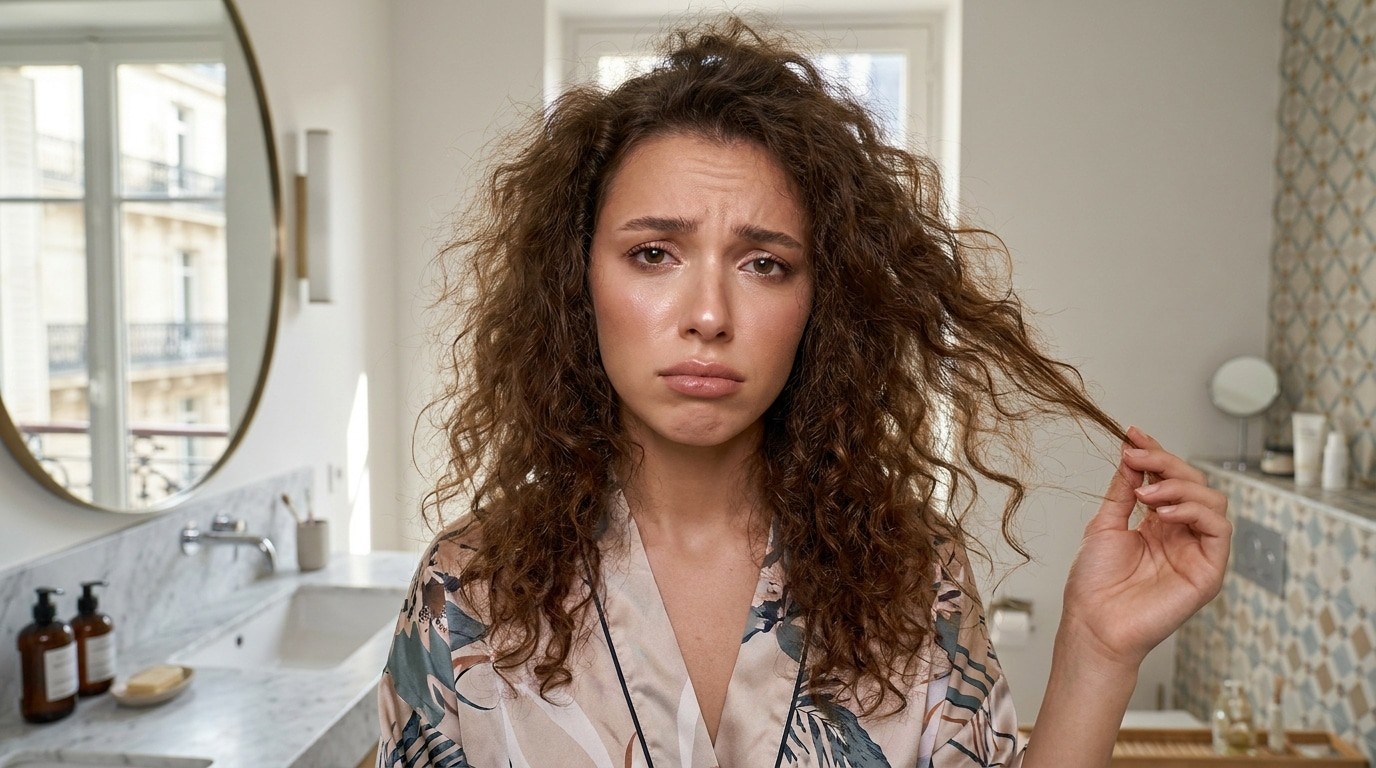
It promises bouncy, shiny curls. Instead, you end up with a dull, fluffy, almost “mousse-like” substance. This gap can be frustrating as it can cause curls to become unruly. But the “cloud effect” is not destiny. Most of the time, very common mistakes cause frizz. Excessive maintenance, especially during washing and drying, can dry out the fibers. When humidity and the first heat wave alternate in spring, curly hair becomes even more sensitive to these effects. Fortunately, you can often restore definition, flexibility and true shine with a few simple, natural adjustments.
1 mistake that ruins your curls in the shower: Washing Too Aggressively
Shampoos that are too “stripping” can give an immediate feeling of cleanliness. But it often leaves curls unprotected. The curly fiber, already drier by nature, lose their lipid film and begin to absorb moisture from the air. This is the gateway to puffinessy effect and lack of shine. The lengths become rough, the curls unravel and the strands separate into small frizzies. To detect this problem, there is one sign that never lies. After rinsing, the hair will “crunches” under your fingers and absorb all the treatments you use, but it will no longer look soft. The gentle cleansing power that focuses on the scalp preserves the shape and shine of the scalp while reducing stress and oiliness.
The basic strategy is to space out washes when possible and prioritize only short scalp massages with the fingertips. This self-cleaning duration is primarily due to the foam that slides off during the rinse cycle. A long rinse with lukewarm water and a final cooler jet often improves the feel of the coat and reduces fluffiness when drying. If you need to refresh your scalp between shampoos, rinse with lukewarm water or dilute a hazelnut-sized amount of shampoo with your hands to avoid stripping effect. The goal is not to “degrease” fat, but to keep the fibers soft and elastic.
Using a conditioner afterwards can make a huge difference, especially when it comes to detangling hair without damaging your curls. When applied to hair well-soaked with water, combs and fingers glide through without getting stuck. A natural and inexpensive tip is to add a micro-drop of olive or jojoba oil to the conditioner in your palm to improve the smoothness of the ends. The product spreads and can be leave it on for the duration of the shower, then rinse partially to maintain a protective veil. This step reduces invisible breakage, improves curl formation, adds shine and reduces puffiness.
“Innocent” Gesture That Breaks the Shape: dry brushing and Handling at the wrong time
Dry brushing is one of the most destructive gestures. It separates strands of hair that should be left in a “ribbons”, creates friction, catches the cuticles and turns curls into halos. The effects are even more pronounced if your hair becomes weakened due to excessive washing. When the air is humid, your hair becomes dull, breakage near the lengths, frays the ends and becomes frizzy. Treating your hair at the wrong time can have similar effects. When the curls start to dry, constant touching, pulling them back into place or “combing” them with your fingers breaking its pattern. Key idea: Less contact when dry, gentler when wet.
The ideal way to find out is to soak wet hair in conditioner and lift it from the ends upwards. Fingers may suffice. Otherwise, using a wide-toothed comb will reduce friction. The movements should be slow, without pulling, and keeping the strands well-dampened. If a knot resists, try adding water instead of forcing it. This method preserves thicker strands and creates more defined curls as they dry. Once knots are undone, your hair will naturally settle effortlessly, giving you “sharper” and “luminous” hair.
Right after shampooing, when hair is still very wet makes all the difference. There are two simple techniques. One is to wrap the strand around your finger to recreate the “ribbon” and the other is to slide the strand around the handle of a wide comb to guide the spring. The goal is not to achieve a perfect spiral everywhere, but to restart areas that swell or deformed areas. Next, the golden rule is to end contact. The shape is set during drying. For a firmer contour, this is the time when contouring products with a sculpted appearance and less darkness * are most common.
It’s funny how we treat our hair like we owe it something. We rub harder, touch more, wait more. Your hair doesn’t care about your efforts. I’m worried about the humidity. Be careful not to irritate it when installing it. If you stop fighting dryness, chances are your curls will eventually stop fighting you too. Or maybe you just keep doing what you want to do.
Heat and friction quietly destroy the precision of the curl. It’s not just that your hair is bad. This is all about physics. Drying your hair at high temperatures with a blow dryer or flat iron on dry hair actually evaporates the moisture from the fibers. This rapid evaporation makes the cuticles rough and uneven. The result? Curls lose their elasticity, absorb moisture from the environment and spread, puffing up into frizz.
In addition, there are towels.
Brushing the hair too hard with a regular terry cloth is a big mistake. It lifts cuticles and separates the clumps of hair that form your natural curl pattern. It’s like putting on a coat and instantly unzipping it. This damage is even more evident in the spring when rain and sunshine alternate. Hair can swell due to humidity, lose structure and collapses.
Dry without scratching
The solution is simple. Press without rubbing.
Use a cotton T-shirt or microfiber cloth instead. These materials absorb moisture without causing friction that ruins the shape of your curls. Wrap your hair gently for a few minutes. This is enough time to get dressed. Drain off the water.
Your goal when using a diffuser is to be patient. Set the heat to low and the airflow to light. Keep away from the tumble dryer. Instead of shaking your head randomly, use a technique often called “hovering” or “pixie diffusing.” Place a section of your hair in the diffuser bowl and hold it there. Don’t shake it. The air keeps the curls in place. This minimizes movement and keeps the cuticle smooth and shiny.
The Scrunch Technique Explained
If you’re looking for a way to improve curl definition without heat, the scrunch is your best friend.
It’s not just random hand movements. Take wet hair and gently push it towards the roots. Think of it as encouraging your hair to spring back. Do this after using a leave-in conditioner or styling cream. Helps spread the product evenly without breaking up natural clumps.
For more staying power, mix a small amount of aloe Vera gel and a hazelnut-sized amount of cream in your palms. Scrunching this mixture in to create tight, grouped curls.
When your hair is completely dry, it can feel stiff or “crunchy”. This is normal. To fix it, take a small amount of oil in your hands and gently squeeze it through the length of the hair. Don’t comb it. Just press. This breaks the cast without creating frizz and leaves you with soft, defined and long-lasting curls.
The Clean vs. Dry Dilemma
It’s easy to fall into the trap of products that promise instant results but leave your hair dry. Many shampoos contain strong sulfates and drying alcohols. They may clean your scalp, but they strip your hair of its natural oils. The result? Porous and dry curls react violently to changes in the weather.
To make matters worse, many people fall into the vicious circle of overcorrection. The hair gets dry, so they pile on heavy creams. This makes it oily and heavy, so wash it off with a strong shampoo. It’s a frustrating cycle.
Break the cycle by simplifying. You don’t need a cupboard full of special products. A mild shampoo and a good detangler are usually enough.
Silicone trap
Silicone is also a common culprit. It instantly creates an even shine and is smooth to the touch. However, they don’t hydrate; they coat. Over time, these coatings can build up on the hair shaft and prevent moisture from penetrating. Curls begin to look dull, lifeless and wrapped in a plastic film.
To remove this build-up, it is often necessary to use a clarifying shampoo, What would be a better approach? Choose products that make your hair soft and pliable rather than slippery and glazed. Observe how your hair reacts after several washes. If you notice coating or dull, switch to a simpler formula.
Simple routines that work
Building a routine doesn’t have to be complicated. Consistency is more important than complexity. Here’s a straightforward framework to keep your curls healthy and in shape.
- Cleanse gently: Use a sulfate-free shampoo intended for the scalp only. Wash thoroughly.
- Thorough treatment: Apply the conditioner to damp hair to detangle. If your hair is thin, Rinse partially If your hair is thick, rinse thoroughly.
- Wet styling: Apply a small amount of leave-in conditioner or aloe Vera gel to the ends. Scrunch it in.
- Dry carefully: Use a T-shirt or microfiber cloth. Minimize manipulation.
- Night protection: Sleep with a soft satin pillowcase or gather your hair loosely to prevent chafing while you sleep.
This structure takes the guesswork out of it. We focus on three things that curly hair really needs: moisture, gentle treatment and consistency. The rest is just noise. When you stop fighting against your hair’s natural texture, you may find that the definition comes back on its own.
Many people with curly hair run into a brick wall. They use their favorite leave-in conditioner or cream. Their hair feels soft. It looks defined. After about an hour, the curls revert to frizz. The moisture is gone. It evaporates.
The reason is simple, but often misunderstood. Water moisturizes and oil provides nutrients, while sealants form a barrier. Without a sealant, the hair cuticle remains open. The water escapes. Moisture causes the fibers to swell and deform, causing them to lose their luster. You will be left with dry, frizzy hair instead of defined rings.
The solution to this problem is the “hydration lock” method. This technique traps the water before it has time to escape. It transforms fragile straw-like lengths into springs that retain their shape. The goal is consistent: Soft and shiny curls that last all day.
How to lock in moisture for curly hair
This method works best on very wet hair. This allows your hair to absorb moisture the best when it’s trapped. Here is the order that matters:
- Moisturization: Use a leave-in conditioner or a little cream. This adds much-needed moisture to your hair.
- Definition: Next, apply a light gel. This keeps the curl pattern in place.
- Sealing: Finally add a few drops of light oil. Focus on the ends. This forms a protective film.
The type of oil you use should be chosen according to the hair’s texture. Thin hair requires a very light film. Heavy oils will weigh it down and look oily. Dense and coarse hair can withstand slightly richer seal.
Common options include argan oil, jojoba oil or a little olive oil. The key is moderation. Use just enough to cover strands without leaving residue. Very porous hair loses moisture faster and needs to be sealed more often. Thin hair needs less product to avoid weighing it down.
The logic is simple, but decisive. When used correctly, it reduces frizz and adds shine. Curls look beautiful and feel softer. It’s not just about looking pretty in the mirror. they will feel good against your fingers.
Beyond the Bottle: Lifestyle Factors for Healthy Curls
Products alone cannot create healthy hair. They support what your body is already doing. If your foundation is weak, no amount of styling will fix it.
Sleep plays an amazing role. A regular sleep schedule helps to maintain the natural balance of the scalp. Adequate rest minimizes hormonal fluctuations that can cause dryness and excess oil.
The next pillar is diet. Hair is made of keratin (a type of protein). If you don’t consume enough protein, your hair will be damaged. A varied diet rich in vegetables and healthy fats is the basis of strong hair. Omega-3 in particular supports scalp health from the inside.
The environment of the scalp is also important. Excessive washing can strip the skin of its natural oils. This sebum is a natural conditioner. If you wash your hair too often, your scalp produces more sebum, creating a vicious cycle that leaves your hair greasy at the roots and dry at the ends. Damage to the scalp can damage hair follicles. Be gentle. Let your scalp produce what it needs.
When you combine these internal habits with external care, the results are predictable. The frizz decreases. The definition increases.


