


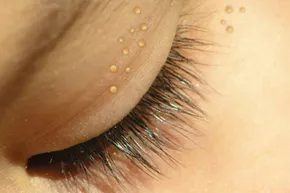
Follow the rules. Remove dead skin. Dead cells are expelled. chase that poreless, airbrushed glow. Yet your face is still covered in tiny, stubborn white bumps that won’t budge.
This is very frustrating. This is very confusing. Frankly? Your diligent routine may be to blame.
Those little pearly cysts are probably milia. It’s not acne. It is not a closed comedone. These are something else entirely, and if you treat them the same way you treat acne, they tend to get worse. In fact, the products you use to keep your skin smooth can be damaging your skin and trapping dead skin cells beneath the surface.
Here are the real facts about what milia are, why they appear on adults’ faces, and how to treat them without leaving scars.
What exactly is Milia?
Milia papules are small, raised white cysts on the surface of the skin. You can usually tell by touching them before you can see them clearly. It feels like hard, fine sand under your skin.
It is common in newborns. Almost all babies develop this condition on their nose and cheeks in the first few weeks of life. It is usually harmless to babies. These bumps will disappear on their own as your baby’s skin matures and learns to shed normally.
Adults get them too. But for us, milia are usually a sign of secondary problems and irritation.
Primary vs. Secondary Milia: Knowing the Difference
Not all milia are created equal. Knowing your type determines whether you need medical attention or just patience.
Primary milia occurs when dead skin cells do not come off the skin. Instead of falling out, they get trapped in little pockets near the oil glands. This is a case of “baby milia”, but it can also occur in adults without other skin conditions. These are usually superficial. It looks like a small dome. There is no itching. They don’t hurt. They just sit there.
Primary milia usually heals on its own within a few weeks or months. No treatment is needed at all, unless you want to remove it for cosmetic reasons.
Secondary milia is different. These phenomena are caused by damage to the skin structure. Something irritates the sweat ducts and oil glands, causing malfunctions. Dead cells are trapped deeper than normal. This type is more persistent. Removing it is even more difficult. And if you pick at it? There is a risk of scarring.
Secondary milia can be caused by:
* Rash and blisters (think poison ivy or severe sunburn)
* Chronic skin diseases such as bullous pemphigoid
* Aggressive spa treatments such as microdermabrasion and chemical peels
* Long-term use of topical steroids
In the case of secondary miliary syndrome, home treatments are rarely effective.
Medical intervention is required.
The real culprit: Why your everyday life is letting you down
You might think that milia are caused by dirt or clogged pores. This is half true. But the other side is irritation.
The skin has a self-cleaning mechanism. Dead cells rise to the surface and come off. When this process is disturbed, milia occur. Here is what usually breaks it.
1. Over-Exfoliation and Trauma
Do you want smooth skin? Aggressive scrubbing can have the opposite effect. Abrasive exfoliants, strong physical exfoliants and rough cleansing tools can cause micro-tears in the skin. The skin reacts to this trauma by thickening the outer layer to protect itself. The thicker the outer layer, the easier it is to trap dead cells.
This is a paradox. We use exfoliants to remove dead skin cells, but exfoliation causes dead skin cells to stick to the skin.
2. Highly comedogenic products
Not all moisturizers are created equal. Some are designed to be occlusive. They seal everything in. Perfect for dry winter skin. This is terrible for milia-prone skin.
Heavy creams, certain make-up removers and oil-based products can block the small openings of the sweat ducts. When the tubes become blocked, the dead cells have nowhere to go. It stays put. Forms a cyst.
Look for products marked Non-comedogenic. But still, if you notice the formation of milia, completely stop using heavy creams on the area.
3. Sun damage
Sunburn doesn’t just cause wrinkles. The skin becomes thicker. Prolonged exposure to sunlight can make the outer layer of your skin harder and less elastic. That toughness traps cells. If you haven’t used sunscreen in years, the dead skin cells on your skin may be thicker and harder to remove. That’s why milia often appear in older adults on the cheeks and around the eyes, i.e. the areas most exposed to the sun.
4. Topical steroids
Did you know that steroid creams can cause milia? If you use prescription steroid creams to treat eczema or rashes, you may be creating an environment where cells become trapped. Steroids can thin the skin over time, but they can also change the way cells are shed and cause cysts to form.
Milia vs. Baby Acne: Don’t Confuse Them
If you’re a new parent, you might be staring at your baby’s face and wondering if those little white bumps are milia or baby acne. Very similar. They appear in the first few weeks of life. But they are different.
Baby acne usually looks like red or pink pimples. You may have whiteheads. This is due to the mother’s hormones circulating in the baby’s body. It usually goes away on its own within a few weeks or months.
Milia are white, pearly, hard bumps. It’s not red. There is no inflammation. They are just there.
Both conditions are usually harmless. Both usually get better without treatment. However, if you are unsure or if the lump persists for more than a few months, contact your pediatrician. Don’t squeeze them. Squeezing the baby’s skin is painful and unnecessary.
Milia treatments: what works and what doesn’t
You have two options. Wait it out or get it out.
The Home Approach (For Primary Milia Only)
Even if your dermatologist confirms that you have primary milia, you have time. These cysts are very superficial. Often it goes away on its own.
What you can do:
* Do not use heavy products. ** Switch to a light, non-comedogenic moisturizer.
Clean gently. ** Use warm water and mild cleanser. Pat dry. Do not rub.
* Avoid exfoliation on the area. ** Peeling will only irritate your skin even more.
be patient. **These issues may take weeks or even months to resolve.
Don’t:
* Do not pick. ** Picking at milia is like trying to pop a balloon filled with hard plastic. The skin breaks. Blood comes out. Scars may remain.
* Do not use needle extraction at home. ** Without proper sterile tools and techniques, infection can occur.
Medical treatment (secondary or persistent miliary disease)
Home treatment does not work if the military illness is serious and continuous or secondary to another illness. We need experts.
A dermatologist can diagnose the type in seconds. In mild cases, find out the underlying skin disease first. If you just want to smooth out the bumps, there are tools you don’t have.
Common treatments include: **
* Extraction: Open the cyst with a sterile lancet and push the keratin beads out with a comedone extractor. It is fast, minimally invasive, and leaves virtually no traces.
* Retinoid creams: Prescription retinoids (such as tretinoin) increase cell turnover. Helps remove dead cells before they get trapped. This takes time, but prevents new Milia from forming.
* Chemical peeling: AHA peeling helps exfoliate the top layer of the skin and release stuck cells.
* Microdermabrasion:** Mechanical exfoliation that removes the outer layer of the skin. It is useful in the treatment of primary Milia, but should be used with caution on sensitive skin.
Conclusion
Milia is not your skincare fail. They are a sign that something is out of balance. Whether it’s over-exfoliating, heavy products, or sun damage, you can tell your skin is feeling stressed.
Please listen. Stop harsh treatments. Simplify your everyday life. If the swelling persists, contact a dermatologist. Don’t scratch or pick at the vanity. Scarring lasts longer than miliary disease.
Your skin wants to heal. Give it space to do so.
What you need to know about skin care and safety
You may not be here to read references, but sources are important when working on your own face. If you’re wondering what to do about those little stubborn whiteheads under your eyes, check out Milia. This is not a disease. It’s just that the trapped keratin. But when you start poking at it with a needle, problems start.
This is actually what the experts said without using medical terminology.
How to treat milia without scarring
Much of the research on milia comes from dermatology databases such as eMedicine and MedlinePlus. The consensus is simple. do not pop them. It’s not acne. There are no holes on the surface. Popping them just creates inflammation and can leave a scar.
So what works?
- Exfoliation. Chemical exfoliants such as AHA and BHA help remove the top layer of skin where keratin is trapped.
-**Retinoids. ** Prescription or over-the-counter retinoids speed up cell turnover. This way, your body will naturally push the bump out. - Professional extraction. If you need to remove it, ask your dermatologist to use a sterile needle. they know where to go. You don’t.
As one source pointed out, minimally invasive procedures can be effective if you have the patience to wait for healing. 🧴
Is it safe to pop a blister?
No. Stop. Just stop.
If you pop a blister yourself, bacteria can enter the bloodstream directly. The liquid inside protects the raw skin. Draining the blood causes the bonds that naturally wrap around the body to fall. Let it heal on its own. If there is pain, cover it with a blister pad. Don’t play surgeon.
Adult acne and warts
Why do adults still get acne? It’s not just hormones. Stress, diet and products can clog your pores. Understanding the development of adult acne means understanding that adult acne is often deeper than Teen acne. It requires different treatment. In addition to tea tree oil, consider prescribing topical and oral medications.
Then there are warts. They look different depending on where they are.
– Plantar warts grow on the feet. They hurt because they grow inward.
– Filiform warts are thin, finger-like growths that usually appear around the mouth or eyes.
– Common warts are bumpy warts that can appear on your hands.
All of them are caused by HPV. Some go away on their own. Some require freezing or salicylic acid. Don’t pick at them. It spreads the virus.
When to worry: moles and jaundice
A new mole? Not always cancer. However, if it changes shape, color, or size, get it checked. Are new moles always a sign of cancer? No. But they can be. Better to be safe than sorry.
Jaundice is different. It’s yellowing of the skin or eyes. It signals liver issues. If you see yellow, don’t wait. See a doctor.
Thin Skin and Cellulite
As we age, our skin becomes thinner. This is why older people are more prone to bruises. Skin thinning means a decrease in collagen and elastin


