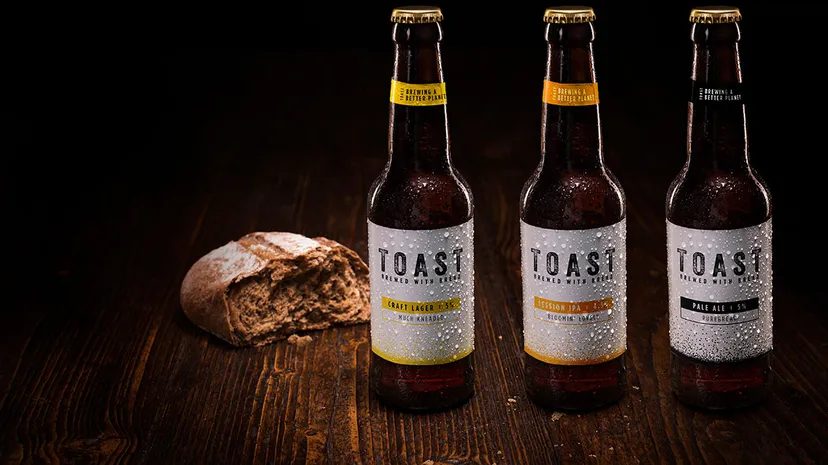
In Great Britain alone, almost 1.1 million tonnes of bread is wasted each year. This mass is equivalent to about 2.73 Empire State Buildings stacked on top of each other. That’s a huge amount of starch, and now a new brewery called Toast Ale is determined to stop it from rotting in a landfill. Instead, they are brewing it into craft beer.
“There’s a slice of bread in every bottle,” says Rob Wilson who holds the playful but serious title of chief toaster at Toast Ale.
Since launching in the UK in 2016, the brand has pulled 11 tons of fresh, surplus loaves from the trash. They crossed the Atlantic in July 2017. The problem is even more serious in the United States: there, up to 40 percent of all food ends up in landfills. Madi Holtzman, the company’s US director, has a specific goal. By this time next year, Toast Ale expects to rescue 907 kilograms of bread monthly in New York alone. That is almost 12 tons per year.
But here’s the twist. The company’s ultimate goal is to make itself obsolete.
If we can do this, there will be no more bread left over to brew Toast beers.
Proceeds from every pint go directly to Feedback, a charity founded by social entrepreneur Tristram Stuart. Stuart came up with the Toast Ale concept. He is a vocal advocate of reducing food waste across the board, not just stale baguettes. He also wants to stop wasting fruit and vegetables, dairy products and meat.
The numbers are scary. The UN Food and Agriculture Organization reports that global food waste is 1.4 billion tons per year. Stuart’s mission in life is to eliminate it completely. If he wins, the supply chain will dry up. No waste means no raw material for beer.
They have a long road ahead.
The Inspiration for Toast Ale
It all started with a trip to Belgium. Stuart tasted Babylone. Babylone is a beer made from fermented bread, the production techniques of which date back 7,000 years. That thought stuck with him. After returning to the UK, he pitched the idea to Wilson, chief toaster at Ashoka, a not-for-profit organization that funds social entrepreneurs. Wilson didn’t just listen. He leaned in.
Why? Because it hit every personal note. Wilson loves craft beer. He hates food waste. He wanted a sustainable business model that actually solves problems. Making beer from unused bread ticked all the boxes.
Six months later, Wilson joined Toast Ale full time. The company is built on four simple pillars. The first step is to create premium products. Next, put the equivalent of a slice of bread in every bottle. Third, talk about the issue without being preachy. Fourth, profits are invested in Feedback, a non-profit organization dedicated to eliminating food waste.
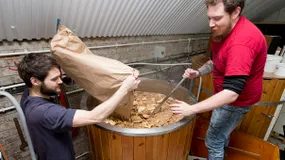
The recipes come directly from the brewers in Belgium. Stuart shared them. Toast refines them. They released a pale ale in collaboration with Ripon’s Hambleton Ales. They brew IPAs and beers in collaboration with Wold Top Brewery in Yorkshire. What is the secret? About one-third of the malted barley is swapped for bread.
Leverage existing infrastructure
Cooperation with an established brewery is not only convenient. This is a strategy to reduce waste. Holtzman explained that building a new facility requires a lot of resources. It is best to use an existing brewery. This way, Toast can focus on the most important thing: recovering more bread.
“Instead of going through the resource-intensive construction of a full facility, we’d like to use our existing brewery so we can focus on maximizing the amount of bread that can be recovered.”
This approach keeps the carbon footprint lower and the expertise higher. They didn’t reinvent the wheel. They just added different ingredients.
The true extent of food waste
Why does so much bread end up in the trash? This is a global crisis. The UN’s goal is to halve food waste by 2030. Feedback, the nonprofit behind Toast Ale, published the report with funding from the Rockefeller Foundation. We looked at supply chains in Peru, Senegal, South Africa, the U.K. and parts of Europe.
The findings were stark. Supermarkets hold the power. They set the conditions for growing, harvesting and transporting food. They demand produce look a certain way. If a carrot is slightly curved, they are thrown away. The costs are paid by the supplier. Supermarkets have no incentive to change.
Bakeries face a different problem. Wheat is heavily subsidized. Flour is cheap. Bakers can afford to bake extra. They want the shelves full. They want to meet unexpected demand.
“Nobody wants to buy that last loaf,” Holtzman said.
If you can’t sell bread, you have three options. A charity. A farm. Landfill.
Where did the bread go?
Toast Ale is strict about its origins. They only take bread that could have fed people.
“The most important thing for us is that we’re not taking bread that could feed humans,” Holtzman said.
But charities often say no often turn it down. In New York, Holtzman collaborated with Bread Alone. This family-owned organic bakery located in Lake Katrine donates leftover bread to charities and farms. Is there anything left? It goes to Toast Ale.
You don’t have to live in New York to drink this beer. Toast Ale is available at Whole Foods in New York. Offered by Food Kick, an online grocery delivery service. They expanded to Iceland and South Africa.
Brew yourself
If you can’t find it in the store, you can also make it yourself. Toast Ale has open-sourced its recipe. Anyone can prepare it at home.
“We’re open-sourcing the recipe so people can make beer at home,” Wilson said. “We’re not precious about that.”
We don’t just sell beer. It’s about spreading the word. This goal is bigger than sales.
“The Ultimate success is that there’s no food wastage, there’s no bread wastage,” Wilson said. “The day we can close the brewery and say, ‘Mission accomplished,’ that’s going to be a great, great day.”
The mission is clear. The method is very simple. Beer is delicious. The rest is up to us.