Forget the movie. This is real cooking. Slow cooking, mostly, but the kind that doesn’t require patience like a virtue. It just requires vegetables that actually care.
Ratatouille. A Provençal classic. A pile of sliced summer in an oven. It’s an ode to seasonal produce, sure, but really it’s an act of organization disguised as food.
It is vibrant. It captures the essence of summer without trying too hard.
You want this when the tomatoes are red and the squashes feel heavy in your hand. Tender squash. Juicy tomatoes. Earthy eggplant. Sweet peppers. They cook down in a sauce that smells like garlic, thyme, basil, and parsley. It’s simple. Elegant? Maybe. But it’s definitely healthy if you define health by eating the dirt-grown stuff directly.
It works as a side. It works as a main. It doesn’t really care how you categorize it.
What You Need
Here’s the inventory. Don’t overcomplicate the chopping.
- 2 eggplants
- 6 Roma tomatoes
- 2 yellow squashes
- 2 zucchinis
- 2 tablespoons olive oil (plus 4 more for the top dressing)
- 1 medium white onion, diced
- 4 cloves garlic, minced (plus 1 teaspoon more for the top dressing)
- 1 red bell pepper, seeded, diced
- 1 yellow bell pepper, seeded, diced
- 28 oz crushed tomatoes
- Fresh herbs:
- 4 tablespoons thinly sliced fresh basil (2 for sauce, 2 for dressing)
- 2 tablespoons finely chopped fresh parsley
- 2 teaspoons fresh thyme leaves
- Kosher salt and freshly ground black pepper, to taste
Note the repetition in the original recipe regarding the basil and garlic. The text listed them twice for different steps. Keep that logic. Some goes in the bottom. Some stays on top.
How to Make It
Preheat your oven. 375°F is the target. (190°C) for those who prefer metric precision.
Get a knife. Or a mandoline. If you have a mandoline, use it, because you’ll be slicing a lot.
The Slicing:
Cut everything. Eggplant. Tomatoes. Squash. Zucchini. Thin rounds. About ¹⁄₁₆-inch thick. (1 mm). Just barely a slice. Set them aside. They need to look organized. Chaos later, but right now? Order.
The Base Sauce:
Grab a 12-inch (30 cm) pan. It has to go in the oven later. Put it on medium-high heat with the olive oil.
Toss in the onion, garlic, and diced bell peppers. Let them sweat. Ten minutes until they’re soft. Soft enough to mash with a spoon if you wanted to, but don’t.
Salt them. Pepper them. Pour in the crushed tomatoes.
Stir it all together until the mixture looks uniform. Then turn off the heat.
Here’s a weird move: stir in two tablespoons of that sliced basil now. Stir it in once. Take a spatula and smooth the top of the red sludge. Flat. Even.
The Architecture:
Start layering the vegetable slices. Eggplant. Tomato. Squash. Zucchini. Keep alternating.
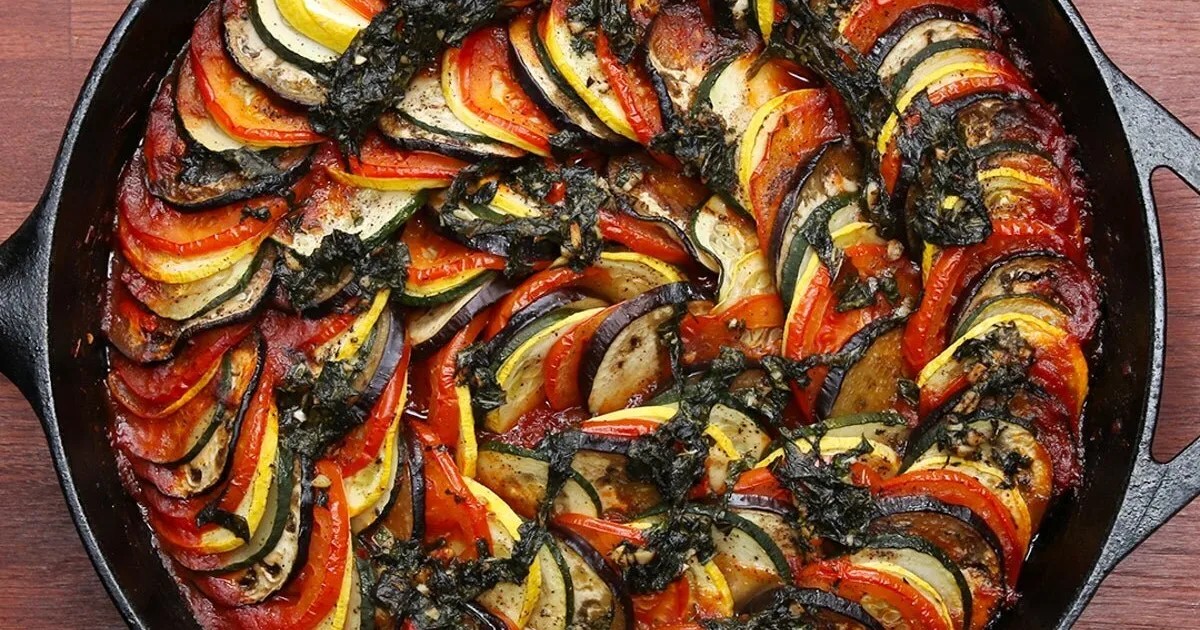
Start from the outer edge of the pan and work toward the center. It looks like a stained-glass window before you bake it. Does it matter if it looks perfect? Yes. You’re serving this to people.
Sprinkle salt and pepper over the whole arrangement.
The Top Dressing:
Make a small herb mixture in a bowl.
* Remaining sliced basil
* Minced garlic
* Chopped parsley
* Thyme leaves
* Salt and pepper
* Remaining 4 tablespoons olive oil
Spoon this over the vegetables. It’s the glaze.
The Bake:
Cover the pan with foil. Tightly.
Bake for 40 minutes.
Remove the foil. The steam will hit you. It smells good.
Bake for another 20 minutes. No cover. Until the vegetables have surrendered and softened completely.
Serving:
Serve it hot. It’s excellent right now.
It is also excellent the next day. Leftovers are underrated here. The flavors merge overnight. To reheat, cover with foil and pop it back in the oven at 350°F (180°C) for 15 minutes. Or microwave it if you’re not a masochist.
The Stats
It’s light. Most of it is water and fiber.
- Calories: 152
- Carbohydrates: 30 g
- Fat: 4 g
- Fiber: 8 g
- Protein: 4 g
- Sugar: 14 g
Four grams of protein. Yeah, I saw that too.
Is it the most nutrient-dense meal ever? Maybe not. But it’s got fiber. Eight grams. That counts for something.
What happens if you add chicken? Probably better nutrition-wise. Probably worse vibe-wise.
Think about the slices again. Thin. Orderly. Then they just melt into each other anyway. We build structure only to watch it collapse.