It took two decades to start
I compete in CrossFit. And HYROX. World-wide.
Born with spina bifida, my spine and cord never formed right. Nerve damage locked my legs for most of my life, wheelchair included. But movement? That’s still mine.
Swimming saved me as a kid. Gave me power. Then life got loud. Fifteen years passed. Zero exercise. I got heavier. Health collapsed. Mental fog settled in. I hated how I looked, how I felt. Lost.
Age thirty-six broke the streak. I decided enough was enough. Wanted better health, less pain. Joined a local gym. Liked the chaos of bootcamp classes where someone told me what to do. Hired a trainer. We worked on function. On muscle. The goal was simple: get through a Tuesday without exhausting myself.
Hard at first. But progress creeps up on you. Heavier weights. More reps. A ceiling that didn’t exist anymore.
The community hook
A year in, an old trainer pointed me toward a CrossFit box. It clicked. Cardio mixed with iron. Functional movement over ego lifting. I tracked the wins. I liked watching the numbers change.
The people got me.
Everyone treated me normal. Not special. Just present. I kept my private training three times a week, but on the off days, I showed up to the box. Fully.
Eighteen months later, forty kilos vanished. Roughly 88 pounds.
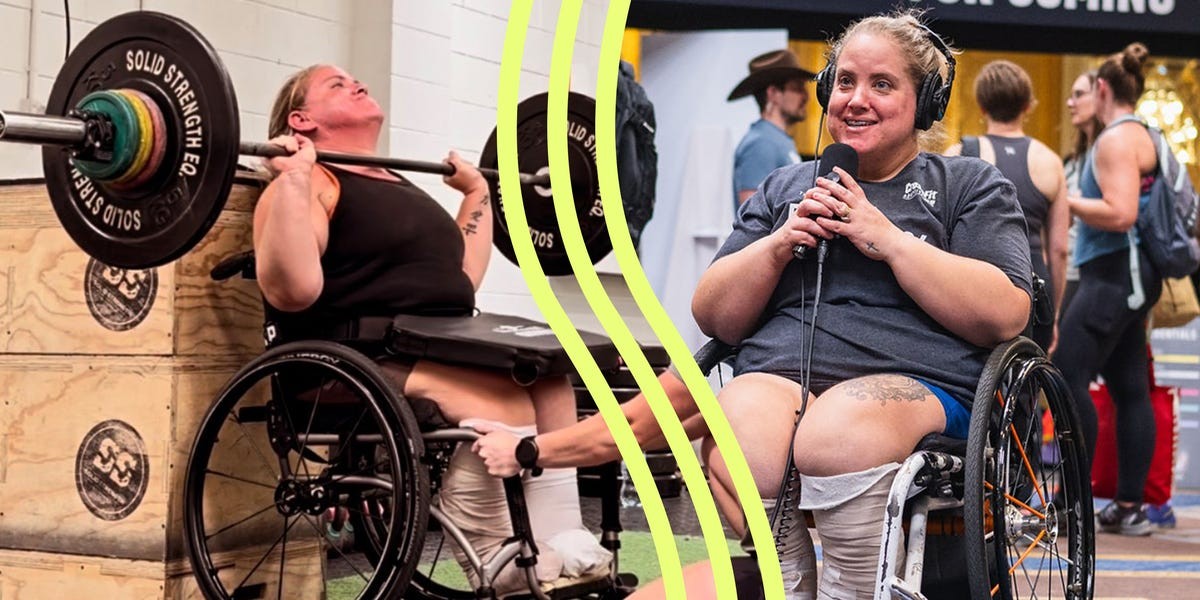
But the scale wasn’t the victory. I could press a barbell overhead. I could pull my own weight up out of the chair on gymnastics rings. Confidence isn’t something you find; you build it like a rep count. I wanted to test it.
So I entered competitions in New Zealand and Australia. Last year, the US. Placed sixth in the Adaptive CrossFit Games.
How it works now
I’m 38 now. The menu shifted to hybrid strength. HYROX prep. CrossFit competition.
Health flares up, so the schedule breathes with my body. Average week looks like this: three CrossFit days, two strength days with an adaptive specialist. Form is everything.
Standard fare includes cleans, overhead presses, rope climbs. A WOD usually hits hard: wall balls, dumbbell presses, sit-ups for time.
Two years ago, HYROX added a layer of endurance hell. Ski ergs from the chair. Wall balls. Sleds attached to my back. Then the run. Eight kilometers total. Pushed by arm strength alone.
Running is brutal.
When I started, one kilometer took forty-five minutes. An hour of work for a single loop. Now, six months in, I do nine kilometers in sixty minutes. Five point five miles. The engine got bigger. Stamina followed.
Three things broke the dam.
1. Stop shrinking. Start being the athlete.
The inner voice used to be venomous. Walking into the gym made my skin crawl. I feared pity. Or worse, being seen only as “disabled girl” instead of a badass lifting heavy metal.
Praise? Deflect it. I’d list every failure instead. Couldn’t take the win.
Now, I sit with it. The shift wasn’t instant, but treating myself like a pro athlete forced respect from within. A psychologist, coaches, real friends helped mute the critic. I started crediting the distance covered, not the gap left behind. Strength looks different on everyone. I decided my way counts.
2. Found my people
The box feels like home now.
In the world at large, disability is the headline. Here, effort is the currency. My team sees the work. The grind. They know the nuance of what it costs to get here.
Competition travel deepens that. Other adaptive athletes on the podium? We share a language of pain and triumph. No explaining required. It changes everything when you stand next to people who know.
3. Refuse the narrative
Doctors told me limits my whole life. List of don’ts.
I decided to ignore the list. Focus on the dos. Prove them wrong. Or better, prove myself right.
Sixth place globally isn’t an accident. It’s adaptation. Taking events not built for wheels and bending them until they work. International HYROX finishes are the same story. Limits are suggestions.
I’m rewriting the script. For me. For anyone who fits the box poorly.
Strength isn’t one shape. Athletics isn’t tied to how your legs move. Expectations are for fitting in.
I’m built to push through.
So, where do we go from here? Half-marathons loom. More races. More weights. The body breaks down, sure. But the will? That keeps turning.