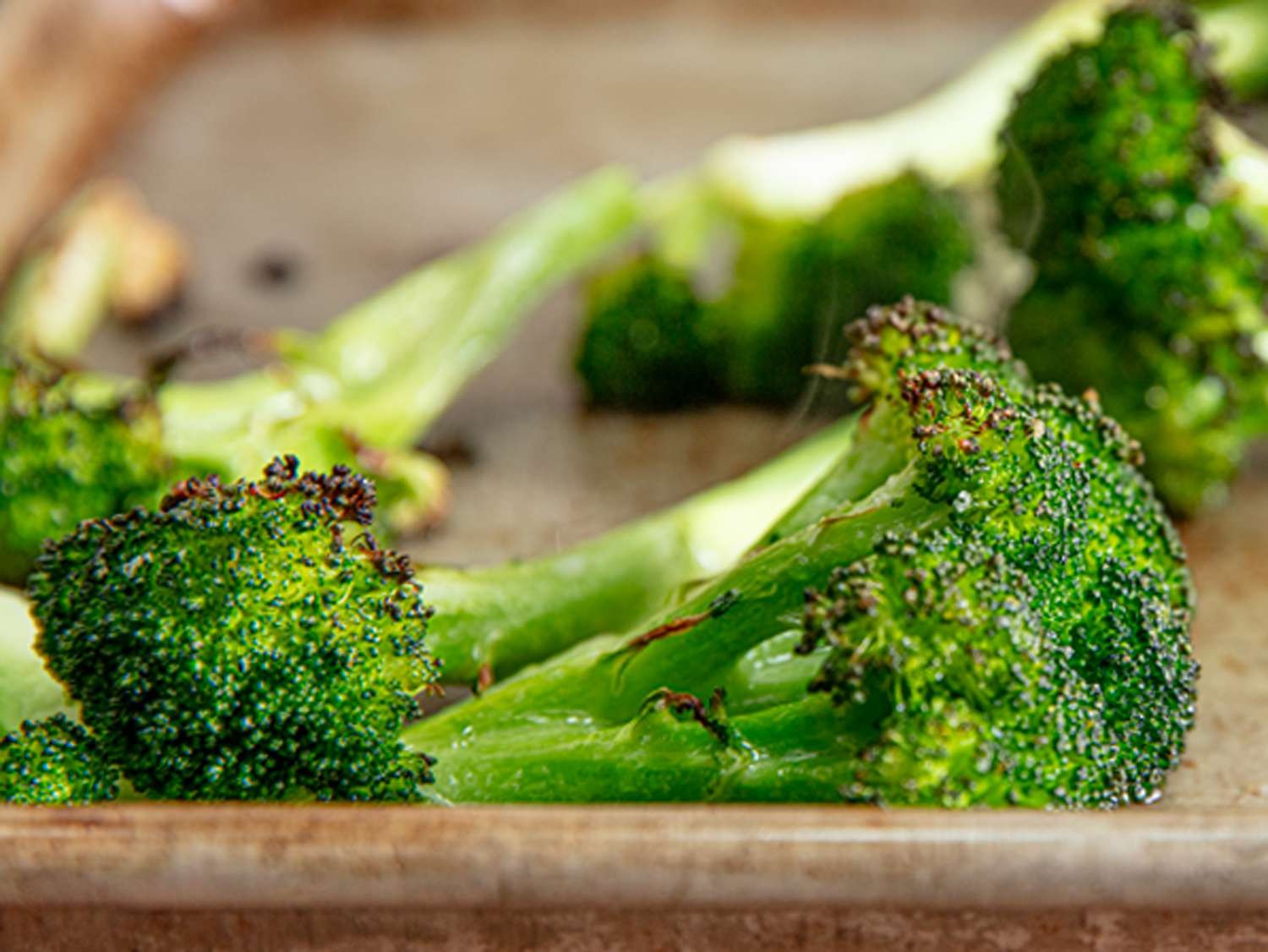
Your roasted broccoli is dry. It’s leathery. It tastes bitter. Stop blaming your cooking skills. Blame the vegetable itself.
Broccoli is a tree-like structure. It is hard to heat evenly. Other veggies? Easy. Sweet potatoes, carrots, and squash. Cut them flat. They touch the sheet pan. They brown uniformly. Broccoli refuses to behave. Even if you slice the stalk, one side is flat. The other? A complex mess of air spaces, tender buds, and thick woody stems.
Botanically, it is an immature flower cluster. You need the stalk to soften without charring the florets into crumbs. This is difficult.
There is a trick. It feels counterintuitive. It involves moisture.
Add a little steam at the very end of roasting. Here is why your dry broccoli needs help, and how to fix it.
The Geometry Problem
Roasting usually means dry heat. You want browning. You want the Maillard reaction. But broccoli has too many surface areas relative to its volume. Heat hits the outside while the inside remains raw or, conversely, dries out completely.
I used to hate opening the oven. Charred broccoli is wasted time. I pulled it early to save the florets. Result? Tough, crisp stalks. Unpleasant.
The solution is not to change the oven temperature initially. It is to change the last ten minutes.
The Steam Trick Explained
Pull the pan from the oven when the broccoli is browned but not tender. Do not serve it yet.
Cover the pan tightly with foil. Trap the steam. Let it sit for ten minutes.
Alternatively, put the covered tray back in the turned-off oven. Let the residual heat work for five minutes.
Open the foil. The broccoli is tender. The florets are intact. The stalks yield.
I tried other methods. Microwaving first? It slowed down browning. Steaming before roasting? The results were worse.
Roasting first, then steaming, wins on flavor every time.
Why? Two theories.
One: Microwave heat kills myrosinase activity. This enzyme helps develop certain flavor molecules. Kill the enzyme, lose the flavor.
Two: Harold McGee suggests steam breaks down structure. This exposes florets to natural acids. Acids can slow the Maillard reaction. Browning suffers.
Steam after roasting avoids these pitfalls. It finishes the cooking without compromising flavor development.
The Science of Latent Heat
Steam is not weak. It is powerful.
We often think of heat and temperature as linear. More heat equals hotter water. That holds true until boiling.
At 100°C, water changes phase. Liquid becomes gas. This requires massive energy. The “latent heat of vaporization.”
It takes 540 calories to turn one gram of boiling water into steam. Raising that same gram from 99°C to 1 trapped heat.
When the steam touches the cooler broccoli, it condenses. It releases those 540 calories directly into the vegetable.
This energy penetrates the air spaces. It softens the thick stalks from the inside out. It works where dry convection fails.
High Heat, Short Time
Heat level matters. I tested 350°F, 425°F, and 500°F.
Low and slow dehydrates broccoli. The open structure lets moisture escape. The result? Leather.
High heat (450-500°F) is better. Short time is key. You want browning before dehydration sets in. High heat also helps sweet flavors develop. Low heat brings out sulfurous, stinky notes.
Don’t baby your broccoli. Blast it with heat.
Turn Off the Fan
Convection ovens circulate air. Fans blow. Exhausts remove moisture.
I love convection for zucchini. Water-rich veggies love concentrated airflow. Broccoli? Not so much.
The fan dries the florets too quickly. It pulls moisture from the air gaps. You get leathery texture before the center is cooked.
Air fryers do the same thing. Same principle. Bad outcome for broccoli.
If your oven has a convection button, leave it off. Stick to traditional bake.
The Result
High heat. No fan. A burst of steam at the end.
Follow these steps and the geometry of broccoli works for you, not against you. The stalk softens. The florets roast. No dryness. No bitterness.
Just good broccoli.
You might think roasting is just about fire. It isn’t. It’s about phase changes. It’s about timing. It’s about understanding that sometimes, the best way to finish a dish is to stop heating it and let it cook in its own environment.
Go try it. Your broccoli will thank you. Or at least, it won’t taste like old rubber.